online
Hiển thị các bài đăng có nhãn design. Hiển thị tất cả bài đăng

Thứ Hai, 12 tháng 8, 2013

Papers, Please is a Game for Grown-ups

Papers, Please is a recent PC game by developer Lucas Pope, which has the player acting as a border officer deciding whom to admit to their country of Arstotzka. The game takes place mainly within a small room acting as a border checkpoint. A long line forms outside waiting to enter your checkpoint, all eager to enter your country.


The player gets five credits for every person processed, and at the end of each day, the money is used to keep their family alive. The player decides how to spend their money on rent, heat, food, and medicine for your family of four dependents. People in line may have excellent sounding reasons as to why they should get to enter even if their papers aren't in order, but you have to balance humanitarianism, penalties from the government, and keeping your family healthy.

I think this is an amazing game, one that could really help reshape peer adult views on the state of video games. Yes--this is, in part, an article about me worrying about the image of video games in popular culture. If that's gross, bail out now! But not before you check out the game, it's excellent!


Appealing Theme


There's very little in Papers, Please that would titillate a pre-teen's interests. While there is a small bit of blood and violence, it's infrequent, and none of it happens because of the player, at least in the traditional manner. There's nudity as well (stylistic, drawn in the game's pixel style, and can be turned off), but it's not at all sexy, and is incorporated as part of the player's job. Deciding to use the body scanner in the game can make you as a player feel uncomfortable. There's typical elements of a FPS such as soldiers, guns, and barricades, but all of it viewed from the bureaucratic side of things. The actions required are skill-based, and time sensitive, but akin to skills developed in the business office, rather than with a controller. The game is difficult, but the second-to-second gameplay comprises analyzing text, correlating information, and following strict rules. It's something that sounds boring to most, but could definitely appeal to 50 and 60 year olds, when cast against the 1980's faux USSR background with the underlying intention of stopping illegal immigrants and supporting your family.
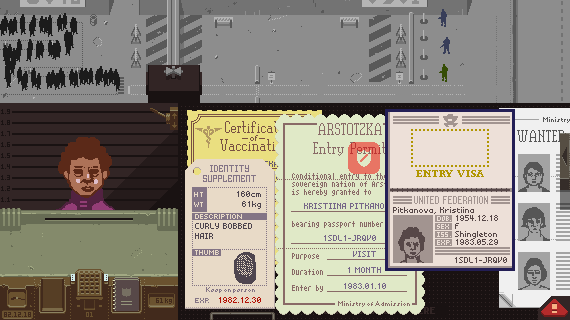


I'm fascinated with how real the characters feel whom you must process at your border station. In The Sims, the player has God-like control over each Sim, but must baby them, telling them exactly what to do: eat, watch TV, or talk to someone else. They feel like automatons, which is fine, as it serves that game. But in Papers, Please all the characters feel like complete people. I suppose it's from a mixture of the background data provided (via their papers), the tiny slice of their life you get to see, their realistic conversations with you, and your imagination. You don't get to follow them around the alley, and see their dull stare into the distance, or aimless wandering (such as in a GTA game). You see them for a moment, and they feel like real people with real problems. The God-like powers promised by a Sims game are realized here, but in a much more powerful way. When you admit or reject someone, you can imagine it having a real impact.

Situational Depth

Your job in the game can have real consequences rendered. All sorts of situations related to border control are explored here, for instance, you could personally stop a human trafficker from getting through, if you know how to do your job. Or you could accidentally let a suicide bomber through, if you miss one crucial bit of information in an effort to process people more quickly and make more money. The depth achieved here, and the situations created is vibrant and memorable. Bribery, misery, compassion, bomb scares, police brutality--all of this and more happens right next to you, and sometimes you're even the cause of it.

Here's a game I think few adults would feel embarrassed to be caught playing. Many of my friends and relatives play Candy Crush Saga or Angry Birds, but if I bring it up they dismiss as "just a dumb time waster." I think because of the concepts explored, and the agency provided to the player, many more adults could be shown the beneficial and positive artistic expression possible within a video game.


Playing Papers, Please made me recall an interview with Jenova Chen in which he laments the lack of appeal of games for adults.

"My biggest complaint for computer games so far is they are not good enough for adults. For adults to enjoy something, they need to have intellectual stimulation, something that's related to real life. Playing poker teaches you how to deceive people, and that's relevant to real life. A headshot with a sniper rifle is not relevant to real life. Games have to be relevant intellectually. You also need depth. You have the adventure -- the thrill of the adventure -- but you want the goosebumps too."

This game is a great place to start for many non-gaming adults. The setting is in the past but the concepts of border control, rivaling nations, and the human element are contemporary. The game is compelling both from what happens at your border job, and from how well you can provide for your family. This is a game that involves genuine sympathy and resolving conflicting responsibilities such as those to your direct boss (and the state), to your family, in addition to what seems morally right.

Few Traditional Game-like Elements

I think it's important for most non-gaming grown-ups, that very little of Papers, Please feels 'gamey'. There's no "morality meter"; you don't grow horns or wings based on how many people you help or hurt.You're paid by the state based on what they want to see happen. It certainly feels like a horrible totalitarian regime, but is it? When they tell you watch out for an enemy of the state and detain them, maybe he really did something bad. Or should you believe his story? Are enough other people's explanations starting to form a pattern in your mind?

 
Having a game that treats the player as a grown-up is as refreshing as having a dramatic game based on a world not too different from reality. While flights of fantasy involving time-travel, blood thirsty orcs, and terrifying aliens is lots of fun (Trust me--I love games with those things!) it's incredible to have a very compelling game, using fairly strict "real world" situations.

Avoiding the Tragedy 

Make sure you try the game. It's 10 bucks over on Steam, but I think there's a free beta version available at the developer's site you could use as a demo. Next, get other people to try it. Non-gamers. Maybe your Dad, or Mom, or Uncle, or those guys and gals at work that talk about politics or sports. Get other people to check out a video game that's not all violence and sex, but still mature and deeply compelling, working with concepts everyone knows. 

Nope, I don't get any kick-back here--I don't know the developer personally. I just want more people to play a video game and see the powerful work that can be done. Or maybe I do benefit from this--the whole industry could benefit from this. Pulling weight along with the likes of Flower, and Cart Life, maybe games such as Papers, Please can get the video game industry out of "The Tragedy of the Comics" within which we may be forever stuck.


(My current game in early development is about pigs that fly in space and eat tennis balls. It's shaping up to be really fun for gamers of all ages, but I'm 38 years old, and that explanation for my work was a little embarrassing to type.)

Thứ Hai, 11 tháng 2, 2013

Profiles in Gonzo Guns: Land Shark Gun

We're releasing Serious Sam Double D XXL on XBLA Feb 20th and it has lots of "gonzo" guns. Before the release, I thought it'd be fun to dissect what makes crazy guns fun in other games. This is a design exploration as to what it takes to make a successful "gonzo" gun. I like the weirder guns in games and hope more games use them since they often push designs in new directions. 


Armed and Dangerous was a funny, third-person game by Planet Moon Studios released on the Xbox back in 2003. The game followed a group of misfit rebels using some basic and some not-so-basic guns to save the day.

The Land Shark Gun in Armed and Dangerous is great because it brings to life a hilarious concept and is well fleshed out.


Concept: The concept is solid, easily understandable, and based on some extension of reality. It expands expectations of what could happen. People have always been safe from sharks on land, what if a shark could reach you even on land? It also helps that it works off a popular, existing media character (the SNL skit from the 70's) and is in the public's mind.

Gameplay: The gameplay is satisfying, while it is basically a fire-and-forget homing missile, it is still very effective and you're able to fire several at once. It takes out basic enemies (most of what you fight in the game) and occupies their time before killing them. It can take out several enemies in succession.


Visual and Audio: The execution is great as a whole. The shark is launched, the fin is clearly visible. When it's close to a target enemy, the enemy stops what he's doing, animates to look around, and even calls out with voice. A pregnant pause as the shark has disappeared underground, and then BOOM, the shark bursts high into the air, devouring the enemy has he screams. (Wow, that sounds terribly gory, but in the context of the game.. it's funny!)


Why It Works in This Game: Armed and Dangerous has many humanoid enemies which can emote fully. They can speak English and animate like humans. This is the quickest way to get ideas across about enemies, and generally hurting/interacting with something. Do it with humanoids. It's much harder if you have complete aliens. Designers and artists usually pull from any human qualities they might have when animating and giving feedback. (That may sound discouraging--and I wouldn't want to discourage designers from exploring more alien designs--but it is an issue if you are trying to convey more human emotions with very alien-like enemies.)

The most common enemy in the game is a soldier type. This is means the shark gun can be used on many enemies effectively which is important to have the player care about it. If the gun is too specialized, it can be something of a let down to use. If there weren't as many soldiers, or you had to wait for too uncommon of a moment, it's tougher to make that appealing.
Also the gun is powerful which helps its appeal. That's not always necessary, but it helps.

Thứ Sáu, 19 tháng 10, 2012

Let's Try No Violence

Thought experiment:
What could we end up as an industry if for the next 5 years, no games with physical violence were made?
What would you make, if your next game could have no physical violence in it?

Defined as: Physical violence you can hear or see. There can still be implied violence. There can still games about revenge, war, crime, you just can't have physical violence shown/heard. Yes, that cuts out the core of most shooter games, but that's sort of the point.

The Witness

Also: The game would ideally be in a new franchise. I suppose it could use an existing franchise (though things like Gears of War and Halo would be tough, but again--could be something interesting from them).

The Unfinished Swan

There are already a lot of independent developers making games with no or limited violence and they've created some very original games. I'd really like all the AAA studios to think about it as well. There are so many hugely-talented people on these massive teams with giant marketing budgets. What could they produce that would then reach the world as the next thing they have to play? Hopefully something different from Farmville?
No Assassin's Creed III, Halo 4, Dishonored, or Call of Duty Black Ops 2. What would those companies make instead? What TV ads would we see?

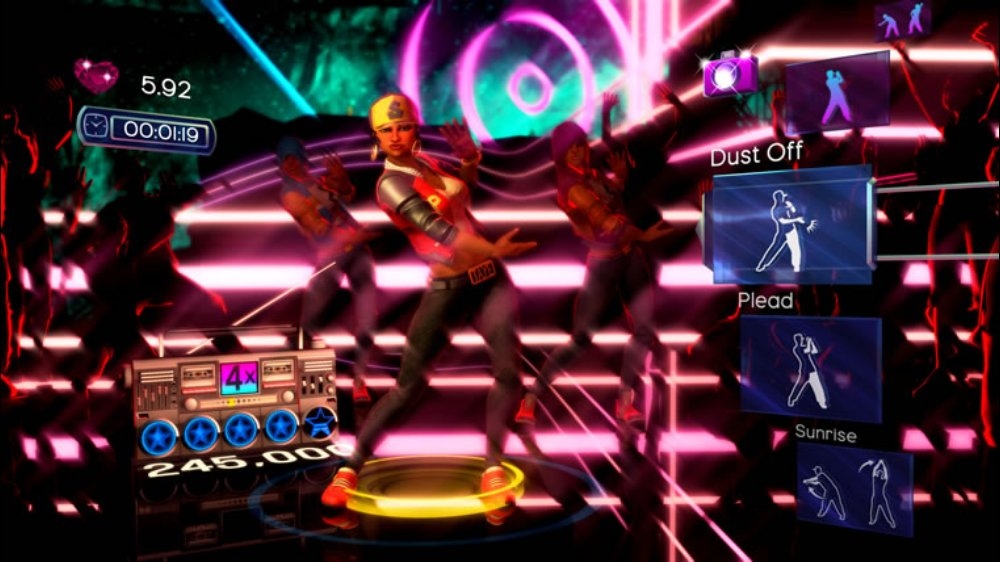
Dance Central
Now, I realize the irony in me asking this as Mommy's Best is finishing an XBLA game in which you stack guns on top of guns on top of guns. (I like guns.) I really like fighting and shooting in games. I like it a lot. But I see games like The Unfinished Swan and I think, what would a whole industry look like if we did that for a while? What if we all pushed in that direction? Sure, we can make violent games again after that--but maybe we'd hit on something so good, we'd keep going?

Super Hexagon
I think I'd do something with expanded social interaction, story-manipulation and very responsive NPCs. I liked where LA Noire was heading in the interrogation sections... I'd probably look at interesting AI for characters interacting and responding to situational changes. A short game, but with lots of breadth to support more interaction options along the way, and additional replays.

Thứ Tư, 26 tháng 9, 2012

The Best Players in the World

How do the best players in the world, play your game? Or how *will* they play your game (if it's still in development)? I think coming at your design from the 'best players in the world' angle can shed light on some possible gaps.

After mulling over an inspired question by Jason Rohrer of his own Diamond Trust of London, "I'm interested to see over time what a really good player of Diamond Trust is", and reading a Super Hexagon tip list by a world-class player, I wondered how the best players of my own games would play them.

We're working to finish our first XBLA game, Serious Sam Double D XXL. It's not out yet, so I don't know yet how the world's best players will climb its leaderboards. But I have a good substitute--myself. If you're a indie dev like me and you're working on a game still to be released, chances are your team includes your game's best players.

You play the game day-in and day-out working on and testing it. You may be using techniques and abilities that are perfectly in-line with your designs, or you may be side-stepping intended gameplay without knowing it. Will your players do this as well?

Here are some questions I've been using and you put to your game:
  • What would you tell others to allow them play as well as you do?
  • Practice writing a small walkthrough for your game before it’s finished. What are you telling players to help them through? 
  • Should you have to tell them these things? What are you explaining that should be better explained within the game itself (hopefully through design, rather than explicit text). 
  • Are you subverting the game design in the way you're playing? Is this intended? 
  • Can you uncover exploits to hopefully redirect players into the intended portion of the game?
  • Best players know the levels and mechanics well. How? Is there a proper introduction of each mechanic?
  • How do you think the best players will discover the deepest tricks of your game? Are they fair and discoverable? Is it fun to suss them out, or will they find them only by accident?
Best Tricks
For instance, In Serious Sam Double D XXL there are campaign levels (with a story) and challenge levels. The campaign levels have leaderboards for quickest level completion time. Based on how I play, I know this means they need to get the Air Buffer gun upgrade, which lets them hover some as long as they shoot. I also know its possible for players to skip a lot of enemy setups. Is this okay? Is this still fun?

Air Buffer in action, encouraged through Speed Run attempts

For me knowing how players (and myself) try to skip enemy setups, can help foster new ideas. This led to creating a shotgun upgrade with pellets that slow down time momentarily for any enemies hit. This combined with the hover ability can get you through fast.

Thinking about this from the original PC release of the game, I realized some setups players were skipping too quickly in any case. Even though the game now registers speed runs, I wanted some spots to give them something more substantial to fight sometimes which led to the introduction of armored enemies.

Exploits
Another aspect of the campaign is collecting currency to spend on new gun upgrades. Similar to getting infinite 1UPs in a Mario game, I know there are a few spots in the game where a player can grind to gain currency. If you have exploits like this, make sure you know about all of them, to properly manage them.

Collecting currency actually helps the simpler setups now as well. In the earlier, easier levels, players will still engage the smaller enemies because they drop currency on death. The original designs of the game had no such system, and no incentive to engage the smallest enemies once players became accustomed to the level setups.

Walkthroughs
Imagine that best player wrote a walkthrough about your game. What are they telling others in order  to perform well that's missing from within the game itself?

New to SSDD XXL, There are over 30 upgrades which let you heavily modify your weapons, some of which are pretty strange. That's a lot of new gameplay to introduce; how do I know players are getting it? This is especially tricky to consider because as the creator you inherently know all the abilities of your guns (or various gameplay).

Bee shotgun in combination with the turret gun
It may sound obvious, but a good place to start explaining things is a description of your guns (or whatever advanced gameplay you have). If there's some advanced technique you regularly employ and expect the player to know, explain it somewhere. For instance, XXL has a 'Cybernetic Bee' upgrade for the shotgun which shoots bees which can lift enemies into the air, stinging them. Cool! But it can also be used against armored enemies. While normal bullets bounce off the armor, the bees can go under their armor. One way to explain this is with text. I do this now, but originally the Cybernetic Bees description only mentioned what they were, not their ability against armored enemies.

A better way is organically letting the player discover abilities. For instance, in the game, the Gunstacker system lets player stack up their guns, allowing players to have multiple guns firing at once. Here players don't have to exclusively try out the bee gun to see it working--it will likely be in a stack anyway, and the results against armored enemies speak for themselves.

Bee shotgun against the new armored soldiers
While I assumed players would be able to figure out that the bee gun can be used on armored enemies, since this is a quasi-required mechanic (not just a secret), it's best to go ahead and explain it wherever possible.

---

I'm still learning about gaps and looking for issues in Serious Sam Double D XXL, but it's getting much better.  With my game still in development, imagining what tricks the world's best player would employ, I can see what areas of the design are being exploited, require shoring up, or better explanations, and hopefully you can do the same for your designs.